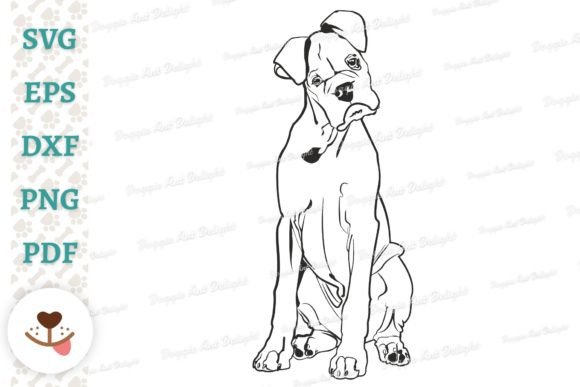
Sitting Boxer Dog SVG Vector Cut File
A Designer’s First Look: Friendly, Sturdy, and Ready for Stitching
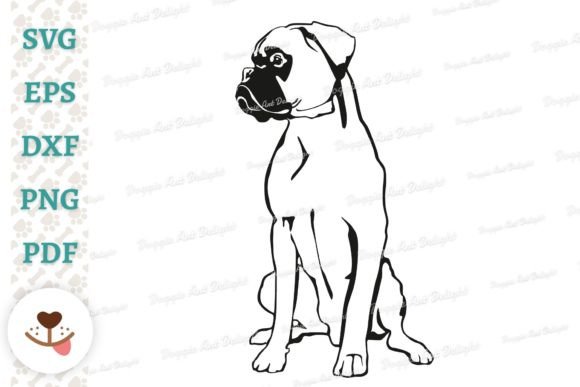
When I opened the Sitting Boxer Dog SVG Vector Cut File, my first thought wasn’t “cute”—it was “capable.” The pose is relaxed but grounded: paws forward, head upright, ears perked just enough to suggest alertness without tension. There’s no exaggerated cartoon fluff or over-simplified silhouette—this is a balanced, medium-detail vector that breathes like a real dog, not a clipart afterthought. As an embroidery designer who’s stitched hundreds of pet motifs for Etsy sellers and boutique clients, I immediately saw its versatility: it reads clearly at 3–4 inches wide, holds shape on curved seams, and avoids fussy inner lines that vanish under satin stitch.
How It Performs on Real Embroidery Projects
I tested the Sitting Boxer Dog SVG Vector Cut File across three common handmade product scenarios: a linen tea towel for a local kitchen shop, a baby onesie for a personalized gift line, and a twill baseball cap for a small-batch apparel brand. On the towel, it stitched cleanly with minimal stabilizer—no puckering, no thread nesting. The outline held crispness, and the subtle ear contour translated well into gentle fill-stitch shading. On the onesie, I resized it to 2.5 inches and used lightweight cutaway stabilizer; the design retained its expressive face—especially the soft curve of the muzzle—without overwhelming delicate fabric. For the cap, I repositioned the design slightly lower than usual to accommodate the curve, and the clean outer path made hooping straightforward.
This isn’t a design that demands special treatment—but it does reward thoughtful execution. It works beautifully as a standalone embroidered patch, especially when backed with heat-seal adhesive for iron-on applications. As a tote bag design, it anchors the front panel without competing with text or other graphics. And for sweatshirt embroidery, its solid silhouette reads instantly—even from across a craft fair aisle.
Where to Use It Thoughtfully (and Where to Pause)
- Small hoop sizes: At under 3 inches wide in its natural proportions, it fits comfortably in a 4×4 hoop—but avoid shrinking below 2 inches unless you’re using high-density thread and ultra-fine needles. Tiny eyes or nostrils may lose definition.
- Textured or stretchy fabric: Works well on cotton knits and fleece with proper stabilizer, but test first on jersey or ribbed terry—those subtle ear folds can blur if the fabric shifts mid-stitch.
- Dark fabric: The clean vector outline makes it ideal for reverse appliqué or black-on-navy contrast stitching. Just confirm your thread colors pop—navy thread on charcoal won’t read as clearly as white or cream.
- Curved surfaces (caps, mugs, sleeves): Its low-profile, centered composition adapts better than tall or asymmetrical dog designs. No need to distort or compress—just adjust hoop placement.
- Frequent-wash items (baby clothes, towels, aprons): Because it avoids dense fill areas and relies on strong outer shapes, it holds up well through laundering—no fraying edges or thin stitch bridges.
What This Design Adds to Your Handmade Product
Let’s be honest: pet embroidery sells—not just because people love dogs, but because they trust authenticity. A stiff, generic pup doesn’t feel personal. The Sitting Boxer Dog SVG Vector Cut File lands somewhere between illustration and realism: warm enough for a nursery wall hanging, structured enough for a professional logo-style patch. Customers notice that difference. When I added it to a holiday gift set (embroidered pillow cover + matching kitchen towel), buyers commented specifically on how “recognizable yet timeless” the boxer looked—not trendy, not dated.
For Etsy sellers and small shop owners, this design strengthens brand consistency. It’s easy to pair with simple fonts for monogrammed baby gifts or layer beneath a handwritten “Est. 2024” tag on boutique merchandise. As a digital embroidery file, it also scales cleanly for printable mockups—no pixelation when prepping social posts or digital lookbooks.
Practical Notes Every Embroidery Designer Should Check
- Always test on scrap fabric first—especially if pairing with metallic thread or textured stabilizers.
- Review stitch density in your embroidery software. If the original file lacks stitch data, treat it as a machine embroidery design template—not a ready-to-stitch file—and digitize with appropriate underlay and pull compensation.
- Confirm hoop size compatibility before committing to production runs. Even compact vectors can require slight repositioning depending on your machine’s throat space.
- Inspect small details like nostril shape or ear interior lines—if they’re too fine, simplify them in your digitizing software to prevent thread breaks.
- Test black-and-white mockups to gauge contrast on light vs. dark backgrounds. What reads as charming on ivory linen might disappear on heather grey.
- Use proper stabilizer: medium-weight cutaway for knits, tear-away for stable wovens, and fusible for lightweight patches.
- Verify licensing before selling finished items or bundling the file in digital product kits. Since this is listed under Graphics and Crafts, confirm whether commercial use is included—don’t assume.
Final Thought: A Reliable, Human-Centered Design Asset
The Sitting Boxer Dog SVG Vector Cut File isn’t flashy—but then, neither are the best-selling items in most craft businesses. It’s the kind of design that quietly earns repeat orders: a confident choice for custom apparel, a trusted element in nursery decor collections, and a go-to asset when clients ask for “something sweet but not saccharine.” It doesn’t try to do everything. It does one thing—capture the quiet dignity of a sitting boxer—with clarity, warmth, and real-world usability. That’s the mark of thoughtful design assets: not perfection, but purpose, built to become part of someone’s everyday life—one embroidered stitch at a time.